
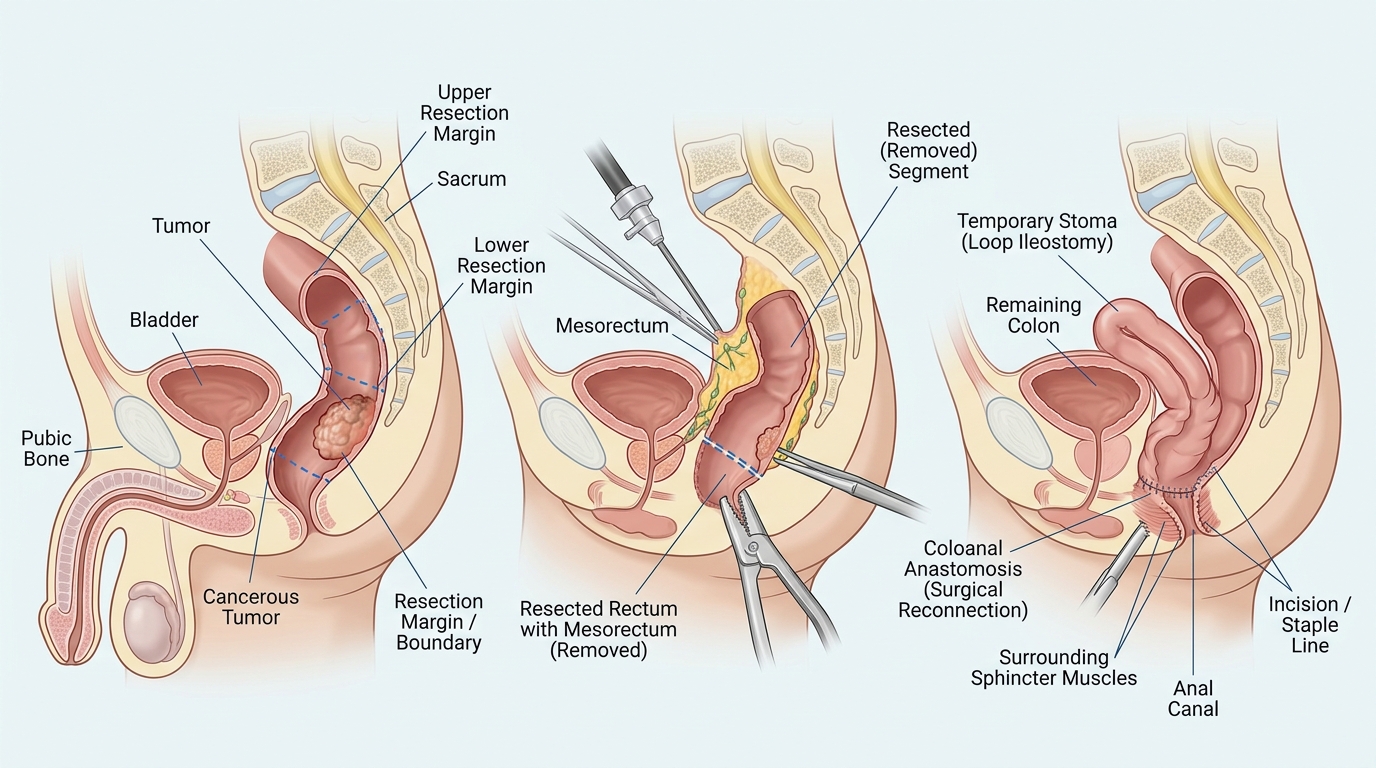
Surgery for rectal cancer
Surgery is the main treatment for most rectal cancers. The aim is to remove the tumour together with enough of the surrounding tissue to control the cancer, while preserving normal bowel, bladder and sexual function wherever that is safely possible.
Which operation is right depends on two things above all: how deeply the cancer has grown, and how low in the rectum it sits. Surgery is often combined with chemotherapy or radiotherapy — before, during or after the operation — to shrink the tumour first or to treat any cells that surgery cannot reach.
The anatomy that decides the operation
The rectum is the final section of the large bowel; it stores stool until it passes through the anus, and the sphincter muscles around the anal canal provide control. Wrapped around the rectum is a layer of fatty tissue called the mesorectum, which carries the blood vessels and the lymph nodes that drain the area. Removing that envelope intact — not just the bowel itself — is the single most important technical factor in preventing the cancer from coming back locally.
Local removal for early tumours
When a cancer is small, superficial and shows no sign of having reached the lymph nodes, it can sometimes be removed through the anus, with no abdominal incision at all. Recovery is quicker than after a full resection.
- Transanal excision — removal through the anus with conventional instruments, often as a day case
- Transanal minimally invasive surgery (TAMIS) — laparoscopic or robotic instruments passed through a port in the anus, giving better control deep in the pelvis
- Endoscopic mucosal resection and submucosal dissection — techniques used mainly for polyps and very early lesions confined to the inner layers of the rectal wall
The limitation is important: local excision does not remove the lymph nodes. If the final pathology shows deeper invasion or features suggesting spread, a more extensive operation or additional treatment is then recommended. Close follow-up after local excision is essential.
Resection that preserves the sphincter
For most cancers that have grown beyond the earliest stage, the affected segment of rectum is removed together with its mesorectum and lymph nodes, and the bowel is then reconnected so that stool still passes the natural way.
- Total mesorectal excision (TME) — the established standard operation: the rectum is removed with the mesorectal envelope intact, giving excellent local cancer control. Most people recover in three to six weeks.
- Low anterior resection (LAR) — used for cancers in the middle and upper rectum. The tumour, surrounding tissue and lymph nodes are removed and the colon is joined to the remaining rectum, so a permanent stoma is usually avoided. A temporary ileostomy is sometimes needed while the join heals.
- Transanal TME (taTME) — the same mesorectal dissection approached through the anus, which can help reach very low tumours that are difficult to access from above.
- Coloanal anastomosis — when the cancer sits very close to the anus, the colon can be joined directly to the anal canal, often hand-sewn, to preserve continence rather than resorting to a permanent colostomy.
- Proctocolectomy — removal of the colon and rectum together, used for multiple or recurrent tumours or when an inherited condition such as familial adenomatous polyposis is involved. Reconstruction with a pouch made from the small intestine (J-pouch) can avoid a permanent stoma in suitable cases.
These operations can be performed open, laparoscopically or robotically. The minimally invasive approaches give better visibility in the narrow pelvis and smaller wounds; the choice depends on the tumour and the individual.
When the sphincter cannot be saved
If the cancer involves the sphincter muscles or sits at the very lowest part of the rectum, removing it safely means removing the anus as well.
- Abdominoperineal resection (APR) — the lower colon, rectum, anus and surrounding tissue are removed, and a permanent colostomy is created. Recovery usually takes three to six weeks. Because of the nerves in this area, APR can affect sexual function and, in men, fertility; these effects should be discussed openly beforehand.
- Pelvic exenteration — a much larger operation, removing the rectum together with neighbouring organs when the cancer has grown into them.
Stomas: temporary and permanent
Many people are anxious about this, so it is worth being clear. A stoma is an opening on the abdomen through which stool passes into a bag — a colostomy when made from the colon, an ileostomy when made from the small intestine.
A stoma may be temporary, protecting a fresh join while it heals and closed at a second, smaller operation weeks or months later, or permanent, when the sphincter has had to be removed or does not work well enough. Whether one is likely in your case, and whether it would be temporary, is planned and explained before surgery.
Recovery and life afterwards
Most people spend several days in hospital and take three to six weeks to recover at home. Eating restarts gradually, and early walking helps the bowel and the lungs recover.
Bowel habits change after rectal surgery: more frequent, urgent or fragmented bowel movements are common in the first months, and usually improve as the bowel adapts. Bladder and sexual function can also be affected because of the nerves running through the pelvis. These are expected topics for follow-up, not things to endure in silence — there is real help available for them.
The pathology report on the removed specimen sets the final stage and guides whether chemotherapy is advised afterwards. Regular follow-up with examination, blood tests, imaging and endoscopy then continues for several years.
Risks to understand
Alongside the general risks of major abdominal surgery — bleeding, infection, blood clots, chest complications, anaesthetic reactions — the specific ones to discuss are leakage at the join in the bowel (anastomotic leak), injury to nearby organs or pelvic nerves, changes in bowel control, sexual and urinary dysfunction, and later scar tissue or an incisional hernia.
Rectal cancer surgery in Beirut, Lebanon
Dr. Samer Deeba is a colorectal surgeon based in Beirut, Lebanon, and Clinical Associate Professor of Surgery at the American University of Beirut. Rectal cancer resection, including laparoscopic and robotic colorectal resections, is among the treatments he performs. If you have been diagnosed with rectal cancer, have a suspicious colonoscopy or MRI result, or want a surgical opinion on a proposed operation and whether the sphincter can be preserved, you can request a consultation. Appointment requests are made through WhatsApp; please keep medical details and reports for the consultation itself.
Sources
General patient information on this page draws on Mayo Clinic — Rectal cancer surgery, written for this site. It is for education only and is not a substitute for a medical consultation.