
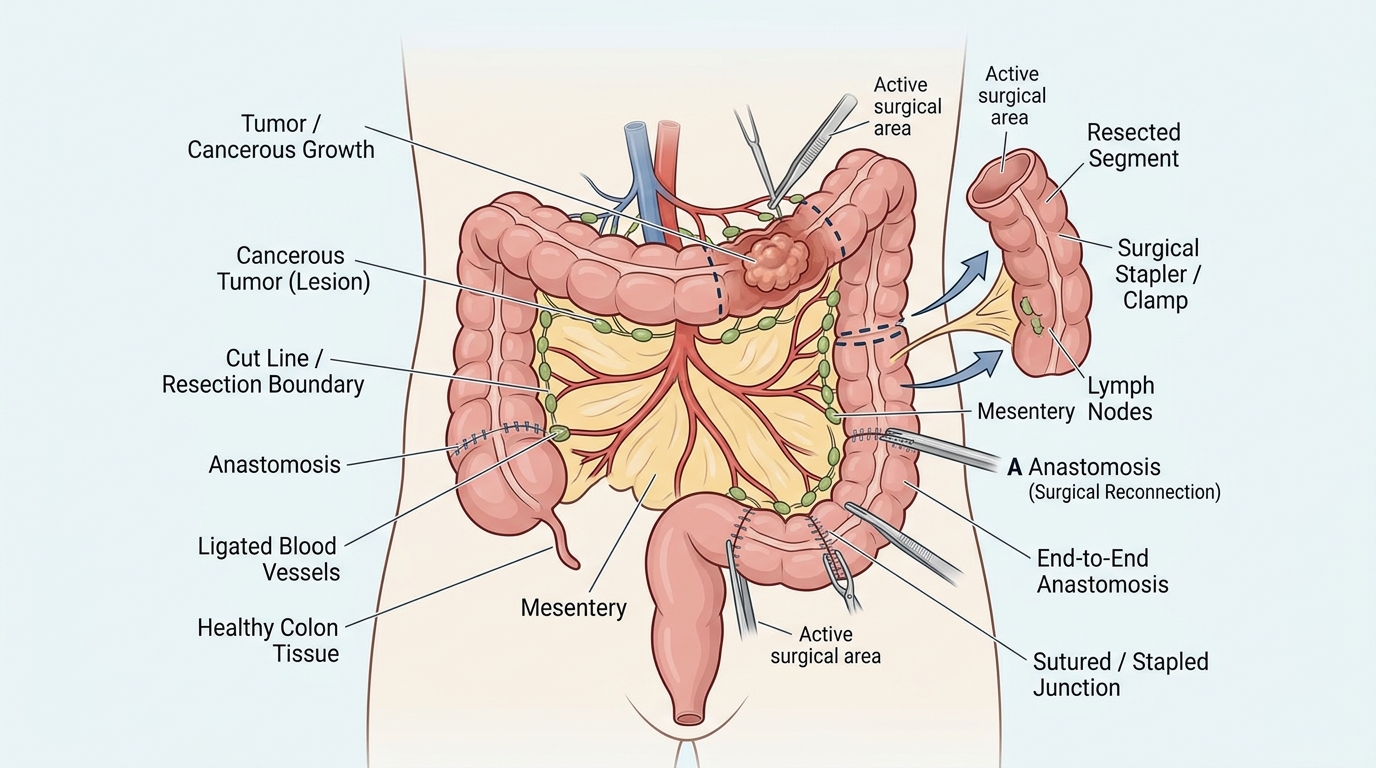
What a colon cancer resection is
A colon cancer resection — a colectomy — is an operation to remove the segment of the large bowel that contains the tumour, together with a margin of healthy bowel on either side and the fatty tissue (mesentery) carrying the blood vessels and lymph nodes that drain it. Removing that whole territory, not just the tumour itself, is what makes the operation a cancer operation: the lymph nodes are examined afterwards to establish the true stage of the disease and guide any further treatment.
Surgery is the main curative treatment for colon cancer. The same operation is also used for other conditions that damage the colon, such as severe diverticulitis, inflammatory bowel disease, obstruction or persistent bleeding, and sometimes as a preventive measure in inherited conditions that carry a very high cancer risk, such as Lynch syndrome or familial adenomatous polyposis.
How much colon is removed
The extent of the resection depends on where the tumour sits and which blood vessels supply it:
- Right or left hemicolectomy — removal of one side of the colon
- Sigmoid colectomy — removal of the sigmoid colon, the last loop before the rectum
- Extended or subtotal colectomy — a longer segment, when the tumour's position or multiple lesions require it
- Total colectomy or proctocolectomy — the whole colon, with the rectum in some cases
This is planned before surgery from the colonoscopy findings and the staging scans, and confirmed in the operating room.
Preparing for surgery
Because a colectomy is major surgery, preparation matters. Before the operation you can expect blood tests, an assessment of your heart and general fitness, a colonoscopy report and imaging such as a CT scan to stage the disease.
In the days beforehand you will usually be asked to follow specific dietary instructions, sometimes including a clear-liquid diet and a bowel preparation to empty the intestine, and to stop eating and drinking from midnight before surgery. You will also need someone to take you home when you are discharged. Exact instructions — including which of your regular medicines to pause — are given individually.
What happens during the operation
1. General anaesthesia is given; you are asleep throughout. 2. Access is gained either through several small incisions (laparoscopic or robotic surgery) or through one longer incision (open surgery). 3. The blood vessels supplying the affected segment are sealed and divided, and the mesentery with its lymph nodes is taken with the specimen. 4. The diseased segment is divided at both ends and removed. 5. The two healthy ends are joined back together — an anastomosis — usually with a surgical stapler or sutures.
A colectomy typically takes between one and four hours.
Joining the bowel, or a temporary stoma
In most planned colon cancer resections the bowel is rejoined and stool passes normally again once the gut recovers. When rejoining is not safe or not possible — for example in emergency surgery, in the presence of infection, or when the tissue needs time to heal — the bowel is brought out to the skin as a stoma (colostomy or ileostomy) and emptied into a bag. A stoma may be temporary, with a second operation later to restore the connection, or permanent. Whether one is likely in your case is discussed openly before surgery, never as a surprise afterwards.
Laparoscopic and robotic approaches
Where the tumour and the patient are suitable, the resection can be performed through small incisions using laparoscopic or robotic instruments. The oncological principles are the same, but the smaller wounds usually mean less postoperative pain, a shorter hospital stay and a faster return to normal activity. Some situations — very large or locally advanced tumours, extensive previous surgery, emergencies — are better and more safely served by an open operation.
Recovery
Most people stay in hospital from a few days up to a week. Immediately after surgery the intestine needs time before it can handle food, so intake starts with fluids and soft food and is advanced gradually. Early walking is encouraged, as it speeds the return of bowel function and reduces the risk of clots and chest problems.
At home, full recovery takes up to about six weeks, though many people are back to most of their usual routine within a couple of weeks. A lower-fibre diet is often advised for the first weeks, after which foods are reintroduced steadily. Loose or more frequent stools are common early on and usually improve as the remaining colon adapts.
Risks to understand
Every major abdominal operation carries risks, and they should be discussed frankly before you consent. They include:
- Anastomotic leak — leakage at the join in the bowel, which may require further treatment or surgery
- Bleeding
- Wound or abdominal infection
- Injury to nearby organs
- General risks such as blood clots, chest infection and reactions to anaesthesia
- Later on, scar tissue (adhesions) causing bowel obstruction, or a hernia at an incision
After treatment
The removed specimen is examined by a pathologist, and the final stage — including how many lymph nodes were involved — determines whether chemotherapy is recommended in addition to surgery. Follow-up afterwards typically combines clinical review, blood tests, imaging and repeat colonoscopy at set intervals, since finding any recurrence early gives the best chance of treating it.
Colon cancer surgery in Beirut, Lebanon
Dr. Samer Deeba is a colorectal surgeon based in Beirut, Lebanon, and Clinical Associate Professor of Surgery at the American University of Beirut. Colon cancer resection, including laparoscopic and robotic colorectal resections, is among the treatments he performs. If you have been diagnosed with colon cancer, have a suspicious colonoscopy or biopsy result, or want a surgical opinion on a recommended operation, you can request a consultation. Appointment requests are made through WhatsApp; please keep medical details and reports for the consultation itself.
Sources
General patient information on this page draws on Cleveland Clinic — Colectomy (Bowel Resection Surgery), written for this site. It is for education only and is not a substitute for a medical consultation.