
What pelvic floor reconstruction treats
The pelvic floor is the layer of muscle, ligament and connective tissue that supports the rectum, bladder and, in women, the uterus and vagina, and helps hold everything in position while allowing controlled emptying. When that support weakens or is damaged, the organs it holds can descend or protrude and normal control is lost.
From a colorectal point of view, the problems that bring people to surgery are usually:
- Rectal prolapse — part or all of the rectal wall turning down through the anus, either visible on straining or fully protruding
- Internal prolapse and rectocele — descent that is not visible outside but blocks or fragments bowel emptying
- Obstructed defecation — persistent straining, incomplete emptying, and the need to press or reposition to pass stool
- Faecal incontinence — leakage or urgency from weak or torn sphincter muscles, often after childbirth injury or previous anal surgery
- A damaged or narrowed anal canal — after injury, infection or earlier operations
These conditions frequently occur together, which is why assessment looks at the whole pelvic floor rather than one organ.
Assessment first
Reconstruction is planned, not improvised. Assessment usually involves examination at rest and on straining, sometimes an examination under anaesthetic, and investigations such as defecating proctography or MRI to see how the pelvic floor behaves during emptying, anorectal physiology testing to measure sphincter pressures, and endoanal ultrasound to look for a sphincter defect. Colonoscopy may be needed to exclude other causes of symptoms.
Many people improve substantially without an operation — with fibre and fluid adjustments, laxatives or bowel-retraining, and above all supervised pelvic floor physiotherapy with biofeedback. Surgery is considered when symptoms remain significant despite these measures, or when the prolapse itself is the obvious mechanical problem.
Rectopexy — putting the rectum back and holding it there
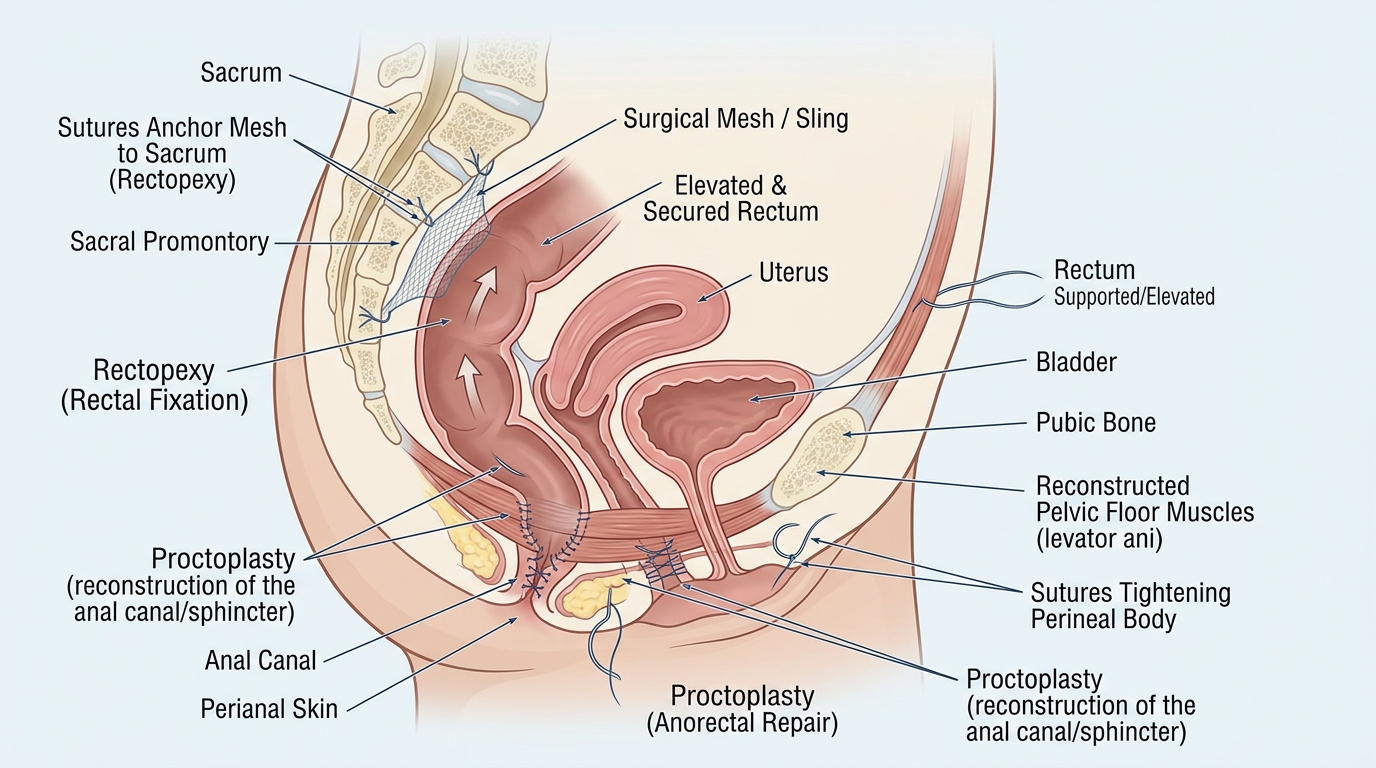
Rectopexy is the abdominal repair for rectal prolapse. The rectum is freed from surrounding tissue, lifted back into its normal position, and secured to the strong ligament over the sacral promontory at the back of the pelvis, either directly with sutures or with the support of a mesh or biological graft.
- Ventral mesh rectopexy dissects only the front of the rectum and supports it with a graft fixed to the sacrum. Because the nerves running behind and beside the rectum are left undisturbed, the risk of nerve injury is lower, and it tends to relieve constipation better than older techniques. It has become the preferred abdominal repair in many pelvic floor units.
- Posterior (Wells) rectopexy places the mesh behind and beside the rectum. It is effective, though recurrence rates rise with longer follow-up compared with the ventral repair.
- Suture rectopexy without mesh fixes the rectum directly and remains a reasonable option in selected cases.
Rectopexy is usually performed laparoscopically or robotically through small incisions, which shortens hospital stay and recovery.
Perineal repairs
When someone is elderly or has significant medical problems that make abdominal surgery risky, the prolapse can be dealt with from below instead, without entering the abdomen. Delorme's procedure removes the excess lining and pleats the muscle wall; Altemeier's procedure removes the protruding segment and rejoins the bowel. Recovery is quick and the operation is well tolerated, but recurrence is more likely than after an abdominal rectopexy — a trade-off that is discussed openly when choosing.
Proctoplasty and sphincter repair
Proctoplasty means reconstructing the anal canal and sphincter itself: repairing a torn sphincter by overlapping the divided ends, rebuilding the perineal body between the anal canal and vagina, or widening a canal that has become scarred and narrow. Combined with levator repair, it aims at continence and comfort rather than at position, and is often planned alongside a prolapse repair when both problems are present.
Where several compartments of the pelvic floor are involved, treatment is best planned together with colleagues in urogynaecology and urology, so that one operation addresses the whole problem.
Recovery
Most people go home within a few days after a laparoscopic or robotic rectopexy, and within a similar time after a perineal repair. Stool softeners are used deliberately in the early weeks: straining is the very thing the repair needs protecting from. Heavy lifting and strenuous exercise are avoided for around six weeks while healing consolidates, and pelvic floor physiotherapy after surgery makes a real difference to the final result.
Bowel habit often takes weeks to months to settle, and improvement in urgency or leakage can continue over that period rather than appearing at once.
Risks and honest expectations
Alongside the general risks of pelvic surgery — bleeding, infection, blood clots, injury to nearby structures including the ureter, bowel or nerves — the specific ones to weigh are recurrence of the prolapse, new or persisting constipation or urgency, mesh-related problems such as erosion (uncommon but a recognised reason for careful patient selection), and, for perineal approaches, a higher chance that the prolapse returns.
These operations improve symptoms and quality of life for most people, but they rarely restore a completely normal pelvic floor. Realistic goals agreed before surgery matter as much as the technique used.
Pelvic floor reconstruction in Beirut, Lebanon
Dr. Samer Deeba is a colorectal surgeon based in Beirut, Lebanon, and Clinical Associate Professor of Surgery at the American University of Beirut. Pelvic floor reconstruction, including proctoplasty and rectopexy, is among the treatments he performs. If you have a rectal prolapse, difficulty emptying, or problems with bowel control, you can request a consultation to have the problem assessed and the options explained. Appointment requests are made through WhatsApp; please keep medical details and reports for the consultation itself.
Sources
General patient information on this page draws on Surgical approaches for complete rectal prolapse, World Journal of Gastrointestinal Surgery and Johns Hopkins Medicine — Pelvic prolapse repair, written for this site. It is for education only and is not a substitute for a medical consultation.