
Understanding the condition
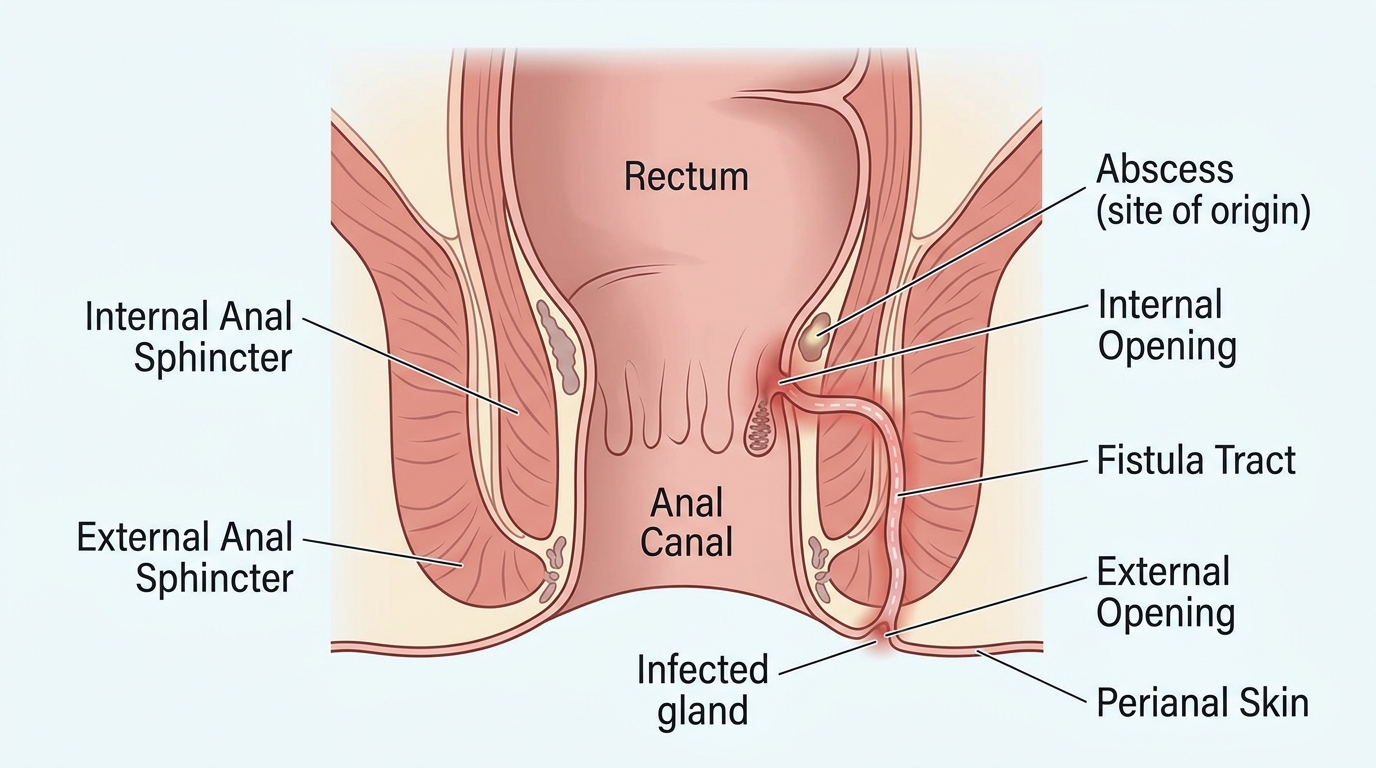
A fistula is a tunnel that should not be there. In the anal region, it forms a connection between the inside of the anal canal and the skin of the buttock, so that fluid can travel along it in one or both directions. Once this tunnel has formed and matured, it rarely closes by itself.
How a fistula usually begins
Deep inside the anus sit small glands whose job is to produce mucus. If bacteria get into one of these glands, the gland becomes blocked and infected, and pus collects next to the anus. This collection is called a perianal abscess, and it typically causes sudden, severe pain with swelling and sometimes fever.
An abscess is an emergency in the sense that the pus must be released — either by a surgeon or by the abscess bursting on its own. But draining the pus solves only part of the problem. In roughly half of cases, the gland that started the infection keeps a narrow channel open between the inside of the anus and the skin. That remaining channel is the fistula. Most people notice it when a small opening near the anus keeps leaking or keeps re-forming after an abscess seems to have healed.
Fistulas of this kind are more frequent in men than in women, and having had one abscess raises the chance of another.
What you may notice
The typical picture is a combination of:
- Discomfort or pain around the anus — often a constant, throbbing ache that sharpens with bowel movements, sitting, or coughing
- A draining opening in the skin — a small spot that leaks pus, blood-stained fluid, or occasionally stool, and may produce an unpleasant smell that is hard to control
- Recurrent swelling — the area may flare up, settle, and flare up again as the tunnel blocks and re-opens
Some people also experience fever, discomfort when urinating, or episodes of leakage. If a fistula has been present for a long time, the skin around it may become irritated and soggy from constant moisture.
Other causes worth ruling out
An infected gland accounts for the great majority of anal fistulas, but not all of them. The following conditions can also produce fistulas and change how the problem should be managed:
- Crohn's disease and ulcerative colitis — inflammation of the bowel often shows itself around the anus first, and fistulas from these causes behave differently
- Infections — including tuberculosis and certain sexually transmitted infections
- Previous injury, surgery, or radiotherapy in the pelvic area
- Uncommon skin and gland conditions, such as hidradenitis suppurativa
This is one reason a fistula should always be properly assessed rather than simply drained: the treatment of the tunnel depends on what is driving it.
Why a fistula should not be left alone
Left untreated, a fistula usually settles into a cycle — infection builds, pain and swelling return, the tunnel drains, things calm down, and the cycle repeats. With each cycle the tunnel can thicken and branch, which makes later repair more difficult. Rarely, a fistula that has been neglected for many years is associated with cancerous change in its lining. None of these outcomes is inevitable, but all of them argue for early, planned treatment rather than repeated emergency visits.
How the problem is assessed
The first step is a careful examination, which is usually enough to see the external opening and get a sense of the tunnel's direction. Finding the internal opening — the point where the tunnel enters the anal canal — is the key part of the assessment, because the whole surgical plan depends on it. If the examination is too painful, this step is done comfortably under anaesthesia.
Depending on the findings, further tests may include:
- Anoscopy or proctoscopy — a short, lighted instrument that shows the anal canal from inside
- MRI of the pelvis — the most detailed way to map a complex tunnel, its branches, and its relationship to the sphincter muscles
- Endoanal ultrasound — an ultrasound probe that gives similar mapping information
- Fistulography — an older X-ray technique in which contrast is injected along the tunnel
Why the tunnel's route matters
The anal sphincter is made of two muscle rings, internal and external, that together keep bowel control. Every fistula travels some distance relative to these muscles, and surgeons classify fistulas accordingly — from superficial and intersphincteric tunnels that barely involve muscle, through transsphincteric tunnels that cross it, to the rare suprasphincteric and extrasphincteric patterns that travel above or around it.
This classification is not academic. It answers the practical question: how much muscle lies in the path of the tunnel, and how much of it can be divided safely? The more muscle involved, the more careful and gradual the repair must be, because dividing too much sphincter risks affecting continence.
Surgical options
Medication alone will not close an established fistula — surgery is the definitive treatment. In fistulas caused by Crohn's disease that are not actively infected, medical therapy is sometimes used first, but even then surgery is frequently needed.
For simple fistulas — a short, straight tunnel crossing little or no muscle — a fistulotomy is the standard operation. The tunnel is laid open along its length, infected tissue is curetted away, and the wound is left to heal from the inside out over several weeks. It is a single, short procedure with a high success rate, and because so little muscle is involved, continence is preserved.
For complex fistulas — those crossing a significant portion of muscle, with branches, or in patients whose healing or continence is at risk — laying the tunnel open in one step would endanger bowel control. In these cases the operation is staged and reconstructive. A commonly used first step is a seton: a loose surgical thread passed through the tunnel that keeps it open and draining while infection settles, often over weeks to months. Once the area is quiet, a definitive repair is chosen to fit the anatomy — options include advancing healthy tissue to close the internal opening, closing the tract with a plug or sealant, or lifting and ligating the intersphincteric portion of the tract. The choice depends entirely on the individual tunnel, and Dr. Deeba will explain which applies in your case and why.
Whatever the technique, the same two goals govern the operation: eradicate the infection permanently, and protect the sphincter muscles completely.
Consultation in Beirut
Dr. Samer Deeba is a colorectal surgeon in Beirut, Lebanon, and Clinical Associate Professor of Surgery at the American University of Beirut. If you are dealing with a current or previous perianal abscess, ongoing drainage, or recurring pain near the anus, you can request a consultation to have the problem examined and a treatment plan discussed. Booking is done through the WhatsApp button on this site; please keep detailed medical questions for the consultation itself.
Sources
General patient information on this page is based on Cleveland Clinic — Anal Fistula, rewritten for this site. It is for education only and is not a substitute for a medical consultation.