
Minimally invasive colorectal surgery
Bowel resections that once always required a long abdominal incision can, in most cases today, be performed through a few small openings. The operation inside the abdomen is the same — the same segment of bowel, the same blood vessels and lymph nodes, the same reconnection — but the way the surgeon reaches it is different, and that changes the recovery considerably.
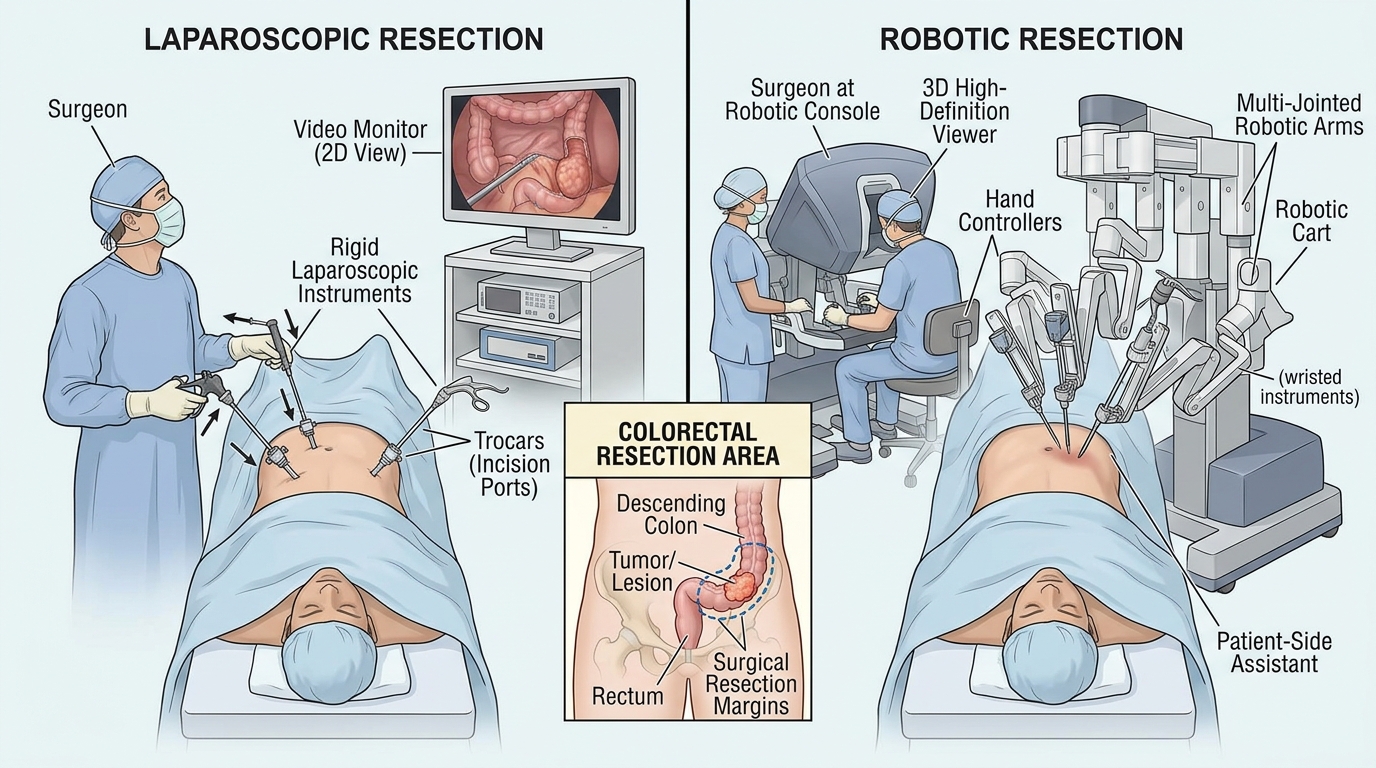
Two minimally invasive techniques are used in colorectal surgery: laparoscopic and robotic.
Laparoscopic resection
Several small ports (trocars) are placed through the abdominal wall. Carbon dioxide gas creates space, a camera transmits the view to a monitor, and the surgeon works with long, rigid instruments passed through the ports. The diseased segment is freed, its blood supply divided, and the specimen removed through one slightly enlarged incision before the bowel is rejoined.
Laparoscopic surgery is well established for colon and rectal resections, with decades of experience behind it.
Robotic resection
In robotic surgery the instruments are still placed through small ports, but they are held by robotic arms and controlled by the surgeon from a console beside the operating table. A patient-side assistant remains at the table throughout. The surgeon looks into a high-definition three-dimensional viewer and moves hand controllers; the instruments have wrists that bend and rotate in ways a rigid laparoscopic instrument cannot, and hand tremor is filtered out.
The surgeon is operating throughout — the system does nothing on its own. Its value is in the view and the dexterity, particularly deep in the narrow pelvis where rectal dissection takes place.
Comparing the two
Published comparisons of robotic and laparoscopic rectal cancer resection have found the quality of the cancer operation to be equivalent: similar numbers of lymph nodes retrieved, similar resection margins, and similar rates of complications, with no difference in early recurrence. Robotic operations tend to take longer in the operating room, while conversion to open surgery is less frequent.
In other words, neither approach is simply "better". Both are sound, and the sensible choice is the one that best fits the individual case and gives the surgeon the safest working conditions for that particular tumour and that particular patient.
What minimally invasive surgery offers
Compared with a single long incision, the small-incision approaches generally mean:
- Less pain after surgery and less need for strong painkillers
- Smaller scars
- Earlier return of bowel function and earlier eating
- A shorter hospital stay
- A quicker return to work and normal activity
- Fewer wound problems and, in the longer term, fewer incisional hernias
When open surgery is the better choice
Minimally invasive surgery is not right for everyone, and choosing an open operation is a judgement about safety, not a step backwards. It may be preferable when a tumour is very large or has grown into adjacent structures, when extensive scar tissue from previous abdominal surgery makes safe dissection difficult, in emergencies such as perforation or complete obstruction, or when a patient cannot tolerate the positioning and gas pressure the technique requires. A laparoscopic or robotic operation may also be converted to open during surgery if the view or the anatomy demands it — again, a safety decision, not a complication.
Recovery
Recovery is generally faster than after open surgery: walking begins the same or next day, fluids and light food are reintroduced early, and most people go home within a few days. Full recovery still takes several weeks, because the internal healing — especially of the join in the bowel — follows its own timetable regardless of the size of the skin incisions. Heavy lifting is usually avoided for about six weeks.
Which colorectal operations can be done this way
Both techniques are used for colon and rectal cancer resections — right and left hemicolectomy, sigmoid colectomy, low anterior resection, total mesorectal excision — and also for benign conditions such as diverticular disease, inflammatory bowel disease, and for pelvic floor procedures including rectopexy.
Laparoscopic and robotic colorectal surgery in Beirut, Lebanon
Dr. Samer Deeba is a colorectal surgeon based in Beirut, Lebanon, and Clinical Associate Professor of Surgery at the American University of Beirut. Laparoscopic and robotic colorectal resections are among the treatments he performs. If an operation has been recommended for you and you would like to discuss whether it can be done through small incisions, you can request a consultation. Appointment requests are made through WhatsApp; please keep medical details and reports for the consultation itself.
Sources
The comparison of robotic and laparoscopic outcomes on this page reflects the peer-reviewed surgical literature, including Robotic vs Laparoscopic Resection of Rectal Cancer: Short-Term Outcomes of a Case-Control Study, Diseases of the Colon & Rectum, written for this site. It is for education only and is not a substitute for a medical consultation.