
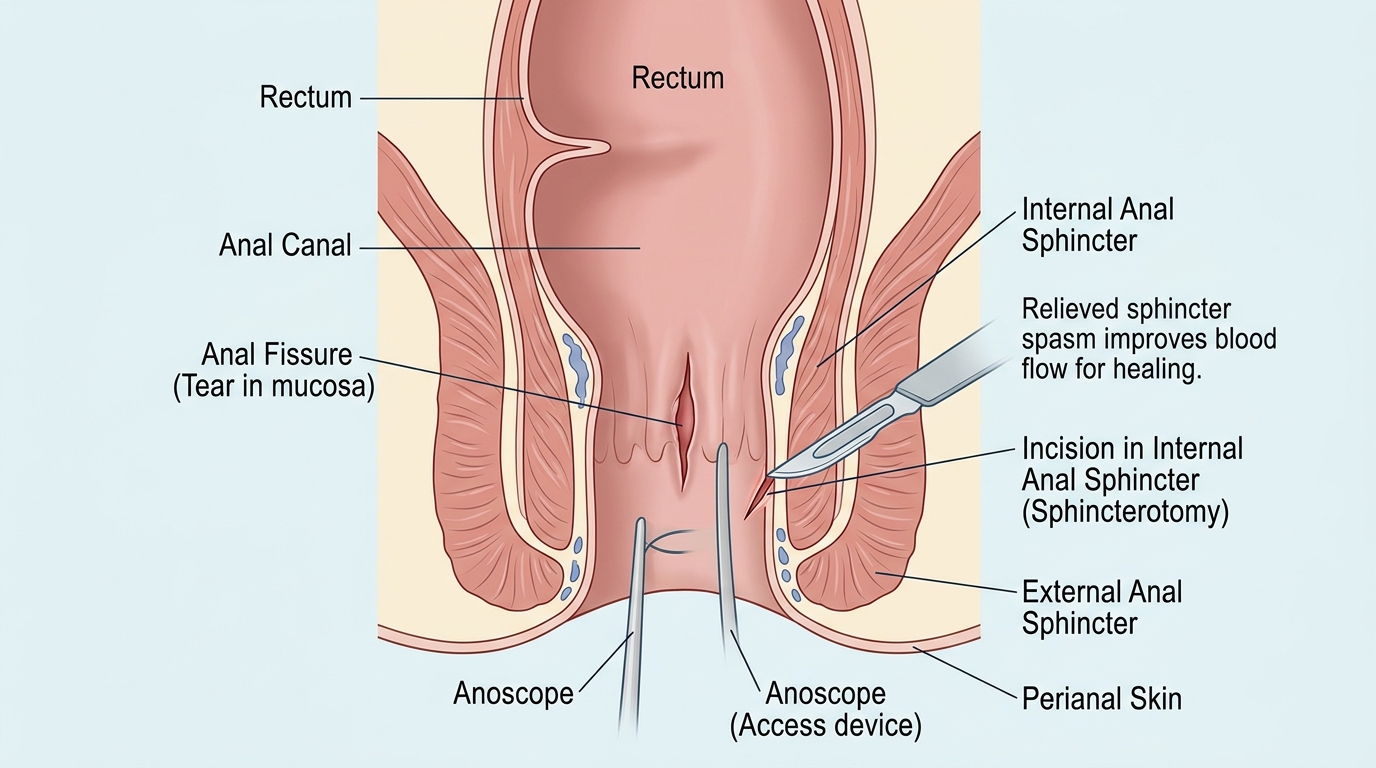
What is an anal fissure?
An anal fissure is a small tear in the thin lining of the anal canal, the short passage at the end of the bowel. The tear itself is tiny, but because the area is packed with nerve endings it can hurt a great deal — many people describe a sharp, cutting pain during a bowel movement, followed by a burning sensation that lingers for hours.
Fissures affect men and women of all ages. Most develop at the back of the anal opening, and most heal on their own within a few weeks.
Symptoms
Typical signs of an anal fissure include:
- Sharp, cutting or tearing pain during a bowel movement, which may continue as a burning or stinging sensation for hours afterwards
- Bright red blood on the stool, on toilet paper or in the toilet bowl
- A visible crack in the skin around the anus
- A small lump or skin tag near the fissure
- In some people, itching or irritation around the anus
The pain can be intense enough that some people become afraid to open their bowels. Avoiding bowel movements leads to harder stools, which makes each passing tear the fissure again — a cycle that keeps the fissure from healing.
What causes an anal fissure?
Most anal fissures are caused by passing large, hard or dry stools, usually related to constipation and straining. Other causes and contributing factors include:
- Chronic diarrhea
- A low-fibre diet
- Childbirth
- Repeated episodes of straining
- Reduced blood flow to the anal area, which becomes more common with age
- Underlying conditions such as Crohn's disease or other inflammatory bowel disease
A fissure that has not healed after roughly eight weeks is considered chronic. Fissures that occur on the side of the anal opening, rather than the back or front, are more likely to be a sign of another condition and always deserve a careful assessment.
Why a fissure sometimes refuses to heal
Pain from the fissure makes the internal anal sphincter — the involuntary ring of muscle that stays gently contracted around the anal canal — go into spasm. The spasm raises the pressure inside the anus and squeezes down the blood supply to the wound. A tear with poor blood flow and constant reopening cannot repair itself, and with time the muscle can become even tighter.
Almost every fissure treatment, from ointments to surgery, works on the same principle: relax the muscle, restore blood flow, and give the wound the chance to close.
How an anal fissure is diagnosed
A doctor can usually diagnose an anal fissure by asking about symptoms and gently examining the area around the anus. Further tests may be needed, especially when bleeding or other symptoms need explaining:
- Anoscopy, in which a short, lighted tube is used to look inside the anal canal
- Flexible sigmoidoscopy or colonoscopy, when other causes of bleeding need to be ruled out, when symptoms suggest an underlying bowel disease, or based on age and risk factors
If the fissure sits on the side of the anal opening, or if there are other warning signs, the doctor may recommend additional testing to look for conditions such as Crohn's disease.
Treatment: starting simple
Most acute fissures settle within a few weeks with:
- Eating more fibre and taking a fibre supplement if needed
- Drinking enough fluids every day
- Warm baths (sitz baths), especially after bowel movements, to relax the muscle and ease pain
- Avoiding straining and sitting on the toilet for long periods
- Stool softeners when stools remain hard
- Topical anaesthetic or other prescription creams, applied as directed
Prescription ointments and injections
For fissures that do not settle, ointments that relax the internal anal sphincter — such as glyceryl trinitrate (GTN) or diltiazem — are commonly used for several weeks. In some cases an injection of botulinum toxin (Botox) into the muscle is used to achieve a similar, temporary relaxation. These measures work for many fissures, but a chronic tear that has resisted them may need surgery.
Surgery: lateral internal sphincterotomy
The operation most often recommended for a chronic anal fissure is a lateral internal sphincterotomy — a small, precise cut in the internal anal sphincter muscle, made at the side of the anal opening (that is what "lateral" refers to).
Why cutting a muscle helps a wound heal
It sounds counter-intuitive, but the cut is not made into the fissure itself. Its purpose is to release the excess tension in the sphincter muscle that is strangling the wound's blood supply. Once the constant pressure drops, the muscle can no longer clamp down in spasm, blood flow to the tear returns, and the fissure is finally able to heal.
The surgeon locates the fissure with a short lighted instrument, then divides a small portion of the internal sphincter beneath it — typically enough to lower the resting pressure in the anus substantially while leaving bowel control intact. The operation takes about half an hour and is done as a day case, so you go home the same day; because anaesthesia is involved, someone else should drive you.
Recovery
Most people are surprised by how manageable recovery is, especially compared with the pain of the fissure itself:
- The first few days bring some wound pain, manageable with tablets, and a little discharge or spotting
- The first bowel movement may be delayed by the anaesthesia, and stool softeners keep it gentle
- Simple habits help: a topical ointment before opening the bowels, warm sitz baths afterwards, rinsing instead of wiping, and propping the feet on a small stool while on the toilet
- Most people are back to normal activities within one to two weeks
The wound itself takes about six weeks to heal completely, but the daily pain usually fades within days — for many people, relief that a chronic fissure had denied them for months.
Benefits and risks
Sphincterotomy is the longest-established operation for chronic anal fissure and is highly effective: the large majority of chronic fissures heal permanently after it. As with any operation there are small general risks, such as bleeding, infection or a reaction to the anaesthesia.
Because the cut involves the sphincter muscle, the specific risks to understand beforehand are:
- Temporary minor leakage — small amounts of wind or stool, usually during the first weeks of healing. This settles for most people.
- Difficulty passing urine for a short time after surgery, which normally improves on its own
- Recurrence — occasionally a fissure returns, particularly if healing was incomplete or another condition is at play
Long-lasting problems with bowel control are uncommon. People who are more prone to them — for example after childbirth injury or previous anal surgery — may be better suited to an alternative, such as a fissurectomy combined with a Botox injection, which relaxes the muscle only temporarily instead of dividing it. This trade-off is exactly what the consultation is for.
Which treatment is appropriate depends entirely on the individual case and is decided after an examination and discussion.
Preventing constipation
Keeping the stools soft protects the healing fissure and helps prevent new ones:
- Eat plenty of fibre — fruit, vegetables, wholegrain cereals and wholemeal bread
- Drink enough fluids throughout the day
- Use a fibre supplement when diet alone is not enough
- Stay physically active
- Do not ignore the urge to open your bowels
- Avoid painkillers containing codeine, which commonly cause constipation
When to seek care promptly
Contact a doctor during recovery — or before it begins — if you notice fever, spreading redness or swelling, heavy or persistent bleeding, foul-smelling discharge, pain that medicines cannot control, or difficulty passing urine.
Anal fissure consultations in Beirut, Lebanon
Dr. Samer Deeba is a colorectal surgeon based in Beirut, Lebanon, and Clinical Associate Professor of Surgery at the American University of Beirut. If you have anal pain during bowel movements, bleeding, or a fissure that has not healed after several weeks of home treatment, you can request a consultation to have it examined and the treatment options — ointments, Botox or sphincterotomy — discussed in person. Appointment requests are made through WhatsApp; please keep medical details for the consultation itself.
Sources
This page summarises general patient information from Mayo Clinic — Anal fissure, the Northern Care Alliance NHS — Anal Fissure patient leaflet and Cleveland Clinic — Lateral Internal Sphincterotomy, rewritten for this site. It is for education only and is not a substitute for a medical consultation.